
Get a 90% discount off Bloomberg’s No.1 competitor. Get a 30-day free trial here
RTC Group (RTC) is an AIM-listed recruitment business located in Derby, UK.
It’s also a nano-cap.
The market cap is £13.31m and the business holds £3.87m in cash and cash equivalents.
The company has zero bank borrowings and operates completely free of term debt, but it does have £2.14m in lease liabilities.
After factoring those in, the enterprise value is £11.58m.
The FCF calculation is relatively simple, in that we can take the OCF figure, and deduct capex and lease costs.
It becomes a little more complex because we can’t strictly rely on the recent averages to guide the forward FCF earnings.
For example, the last 5 years were heavily distorted by the COVID pandemic, the termination of a major contract, and severe rail strikes in the UK.
In FY2025, the business also released £3.6m of cash from unpaid invoices. This pushed the OCF to over £5m.
Averaging all that out over 5 years, gives us a 5Y FCF figure of around £1.5m.
After adjusting for all these distortions, and erring on the side of being conservative, I estimate the ‘normal’ FCF to be roughly £2.2m per year.
This all creates the following valuation ratios:
NCAV Ratio = 3.4
TBV Ratio = 2.9
EV/FCF Ratio = 5.2
P/FCF Ratio = 6
This is very cheap to its earnings, which are pretty reliable over the last 5 years, even if they have been a little ‘bumpy’.
There are also a couple of things that make this particularly compelling.
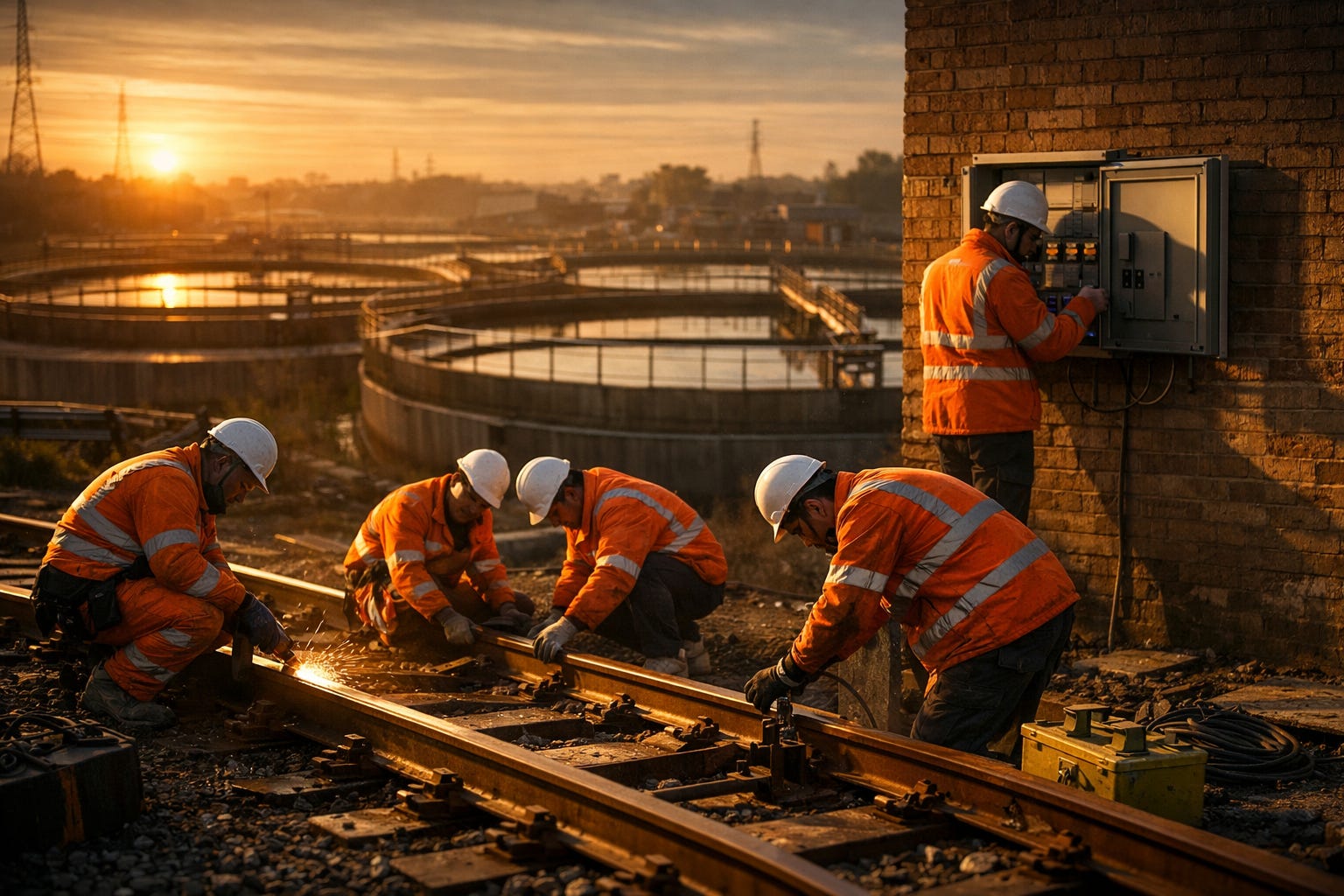
First, the business specialises in capital-intensive industries (rail, water, energy).
This means that it signs long-term contracts and doesn’t suffer from short-term gyrations in the economy.
The client-base is blue-chip.
In 2023, they disclosed that the order book is crammed full and worth £200m over the next few years.
The cash-flows look robust and set to continue.
Second, the management team seems to be very shareholder friendly.
Because there is no real debt, they are returning much of the capital back to the owners, through a combination of dividends and buybacks.
The total yield of all this is around 12%, and looks set to continue for the foreseeable future.
This is after any dilution and SBC activity.
So, we buy a cash-generative, debt-free business with a FCF yield of almost 20%, and receive around 12% while we wait for the price to re-rate.
The ownership structure is also attractive.
While 53% of the stock is in the hands of majority owners, they are highly fragmented and unrelated.
The largest shareholder only controls around 20% and the rest have totals ranging from 4% to 10% each.
This means an activist position is possible, but would take at least one ally from this group of existing owners.
This also means there is a low risk of the business being delisted for nothing because they don’t have enough control to force it through without broad agreement.
All in all, this looks like a solid set up with some nice upside potential.
The Business Model
RTC Group Plc operates through three distinct divisions.
The primary revenue engine is the provision of temporary and contingent labour.
In the 2025 financial year, the Group generated total revenue of £95.5m.
The revenue contribution breaks down as follows:
Temporary Placements: This generated £91.0m, representing 95.3% of total revenue.
Permanent Placements: This generated £2.4m, representing 2.5% of total revenue.
Central Services: This division, which operates The Derby Conference Centre, generated £2.1m, representing 2.2% of total revenue.
RTC doesn’t operate as a standard generalist recruitment agency.
Instead, it provides fully managed workforce solutions in safety-critical environments.
To illustrate:
The Energy Sector: Utility companies face a severe national skills shortage when trying to meet government-mandated smart meter installation targets.
To solve this, RTC established its own dedicated training and assessment centre in Milton Keynes.
They directly recruit, train, and deploy skilled engineers for their clients, providing a full life-cycle workforce solution.
International Logistics: International clients require highly vetted personnel deployed to remote, hostile environments.
For example, in 2024, the Group’s international division wet-leased an Airbus A320 aircraft.
The business then recruited 150 workers from 15 different countries.
It mobilised them to a central location for military security clearance, and successfully deployed them to the Diego Garcia military base for the United States Navy.
All this is one reason I find the set-up so compelling.
Over the last 5 years, they have transitioned more and more away from ‘normal’ recruitment and into long-term partnerships with large companies and governments.
Key clients include, Network Rail, NATO, the US Navy, and several of the UK’s largest utility companies.
The business generates the vast majority of its revenue domestically.
In 2025, the UK market accounted for £88.9m in revenue.
The International division generated £4.4m, servicing clients across the Middle East, Somalia, Poland, and Diego Garcia.
As you’ve probably guessed, RTC holds a market-leading position.
The recruitment market is highly competitive and places significant pressure on margins.
However, it defends its market position by embedding itself into the client supply chain.
By funding apprentice training and operating its own assessment facilities, it makes a mockery of traditional recruiters handing out CVs.
Management Strategy
The goal is to build a diverse and complementary portfolio of sector-specific subsidiaries that act as long-term strategic partners to capital-intensive infrastructure clients.
They also understand how to return capital to shareholders.
Their execution isn’t bad either.
Shareholder yield is double digits and looks set to continue.
They also successfully integrated three different recruitment teams, offering clients a single, comprehensive solution.
They also acquired a company called Ganymede Energy, which has proven to be extremely accretive.
So far, it has returned 5x the original purchase price.
The Operating Business
Revenues over the last few years illustrate this shift away from cyclical recruiter and into a long-term infrastructure partner.
In 2022, revenue declined sharply to £71.9m.
This was driven by widespread industrial action across the UK rail network, which cost the business 75,000 billable hours and £2m in missed revenue.
In 2023, revenue surged to a record £98.8m.
This was driven by the resolution of union disputes and a massive 50% growth, fuelled by government mandates for smart meter installations.
In 2024 and 2025, revenue tapered slightly to £96.8m and £95.5m, respectively.
This slight decline was intentional.
Management deliberately closed the minor rail works and social housing divisions in late 2023.
This was because inflationary pressures on labour and materials reduced the profitability of those specific sectors.
In 2025, the permanent recruitment market experienced a sustained slowdown in demand.
The business successfully offset this 14% drop in permanent recruitment by capturing stronger demand for temporary and contract staff.
They grew temporary contract gross profit by 9%.
Despite these set-backs, the business has proven itself to be a resilient cash-machine.
For example, in 2025, the capex spend on £95.5m in revenue was only £150k.
This means that operating profit typically goes straight into the bottom line and into its owners pockets.
The Growth Profile
RTC isn’t growing.
Revenues are basically flat and will likely remain in the £90m to £100m range for the foreseeable future.
However, the profitability of the business is improving.
For example, gross profit margins were 17.6% in 2023, 18.5% in 2024, and 18.7% in 2025.
EPS has also grown consistently.
They were 12.75p in 2023, 13.01p in 2024, and 14.10p in 2025.
Right now, the equity of the business is £8.19m.
Using our sustainable FCF figure of £2.2m, this equates to an adjusted ROE of over 25%.
This efficiency is even more compelling when we compare it with the capital-return activities of the management team.
They’re currently paying 7% dividends and have retired over 14% of the outstanding shares in the last two years alone.
It’s not a compounder, but it is a healthy, cash-generative business that will likely be around for the foreseeable future.
In other words, the business is incredibly durable.
The Assets
When assessing the assets my goal is to strip out anything that has no value in the real world and look for things that have more real-world value than stated.
The assets are pretty high quality.
Cash = £3.87m
Receivables (invoices) = £9.99m
Contract Assets (unbilled work completed) = £2.41m
I excluded things like prepayments, intangibles, right of use assets, and deferred tax assets.
I’ve only included the fixtures and office equipment component of PPE, which is £500k.
Total liabilities are £12.46m.
Using that adjusted asset base, the NCAV is £3.8m and the TBV is £4.4m.
The positive NCAV alone illustrates the high quality of the asset base.
There aren’t any hidden assets that I could find.
However, there is the order book.
In 2023, management confirmed a secured order book commitment of approximately £200m.
If we compare this to the current EV of £11.58m, it looks like a pretty significant asset.
This is the main source of conviction behind those £2.2m per year FCF figures I calculated earlier.
There is also a sub-lease agreement that guarantees RTC £500k over the next few years.
It’s nothing significant relative to total revenues, but it’s worth mentioning.
All in all, the balance sheet is pristine.
The £8.19m in equity is supported by almost £4m in cash.
Of course, there is no liquidation protection, but this idea rests on the ongoing cash-flows and capital return instead.
The Shareholder Yield
As discussed, the total yield is roughly 12%.
I’m going to ignore the COVID distortion and focus on the last 3 years.
Even during those years, there was no dilution or SBC activity.
Once that period was over, the business started getting serious about capital returns.
In 2023, it paid a dividend of £145k. There was no other activity.
In 2024, they paid out £819k in dividends and £980k in buybacks. There was no dilution or SBC activity.
This generated a net return to shareholders of £1.8m.
2025, was similar.
They paid out £780k in dividends and £851k in buybacks, for a net return of £1.63m.
Even with those COVID distortions, the average yield over the last 5 years was over 5%.
The entire motivation here was for management to return value to existing shareholders.
The Board explicitly enacted these buybacks because the shares were trading at a steep discount to their intrinsic value.
Management noted that acquiring these shares at a significant discount to the market directly benefitted all remaining shareholders.
Going forward, we can expect yields closer to 12% than 5%.
For the 2025 financial year, management proposed a total dividend of 6.71p per share.
This equates to approximately £842k in annual cash pay-outs.
On today’s £13.31m market cap, the dividend alone provides a base yield of 6.3%.
The business sustainably generates approximately £2.2m in owner-free cash flow per year.
After paying out the £842k dividend, the business retains roughly £1.3m in surplus cash annually.
Management has demonstrated a clear, ongoing commitment to using this surplus to aggressively buy back shares and raise dividends further.
This all points to the shareholder yield continuing to be impressive over the next few years.
The Ownership Structure
The ownership structure of RTC Group Plc is highly concentrated.
The business is tightly controlled by a small group of long-term individual investors and insiders.
This concentration protects the company from hostile takeovers but limits the influence of outside activists.
The company only discloses shareholders who hold an interest of 3% or more.
In the 2025 annual report, exactly seven shareholders met this threshold.
Together, these seven individuals hold a combined 53.92% of the total voting power.
Institutional investors only control around 2% of the total stock.
There is strong historical voting alignment between the largest shareholder and the executive board.
The largest shareholder is M L Douie, holding 20.52%.
M L Douie inherited this stake from the late W J C Douie, who passed away in 2023.
W J C Douie was the co-founder and long-time Executive Chairman of the business.
A M Pendlebury is the current Chairman and Chief Executive.
He holds a 5.55% stake.
Pendlebury joined the board as Group Chief Executive in 2007 and ran the company alongside W J C Douie for 16 years.
This deep historical relationship strongly indicates that the Douie family stake (20.52%) and the CEO stake (5.55%) are closely aligned.
Together, this aligned insider group controls 26.07% of the voting block.
There are also no treasury shares.
When they buy back stock they immediately cancel all the shares they purchase so that they are immediately accretive to existing shareholders.
All of this is bad news for an activist, because they could only get control by doing a side-deal with one of the major seven owners.
Given the cash-generation of the business, this would be a pretty hard sell at the current price.
For passive minority owners this situation looks a lot more positive.
Even if the controlling block were fully aligned, they don’t have enough power to force through an involuntary delisting.
The actions of management have also demonstrated high levels of integrity so far.
All of this provides comfort that there is unlikely to be a delisting at an absurdly low stock price any time soon.
The Risks
There are a few specific risks that we should be aware of before buying this stock.
First, there is significant customer concentration.
The business relies heavily on a small number of massive infrastructure clients.
In 2025, just three UK customers generated £23.4m, £10.1m, and £10.7m respectively.
Combined, these three clients delivered £44.2m in revenue.
This represents 46.2% of the total £95.5m Group revenue for 2025.
However, this isn’t quite as bad as it sounds.
The absolute risk of customer default is low.
Obviously they are major corporations and governments.
The relationships are also governed by long-term framework agreements rather than spot-market transactions.
The company also actively utilises credit insurance to protect its debtor book against financial failure.
In other words, the risk of a client disappearing is virtually non-existent, and the risk of them ‘cancelling’ the contract is similarly low.
However, if something like that did happen, it would be catastrophic for RTC.
They are also indirectly exposed to trade union disputes.
The trade union dispute in 2022, resulted in them losing out on £2m in revenue.
The dispute was nothing to do with RTC, but it impacted their ability to work with their client (Network Rail).
Those costs are unrecoverable.
Another exposure is to government regulations and legislation.
For example, the UK government has already implemented pro-employee legislation that has ramped up the cost of labour.
This directly impacts the business model of a business like RTC.
The UK government is also responsible for the infrastructure spending of clients such as Network Rail and the Utility sector.
If spending is cut, it could indirectly impact RTC.
However, it’s also worth noting that even if short-term cuts are enacted, it’s almost certain that spending will resume in these sectors.
Infrastructure is fundamental to the operation of the entire country.
Another compelling feature of RTC at today’s price is that they have already demonstrated impressive resilience.
For example, in 2021, the UK pulled out of Afghanistan. RTC relied on this deployment to supply contract labour for NATO.
This instantly terminated a highly profitable revenue stream.
The business managed the logistical nightmare of safely evacuating all its international contractors.
Instead of collapsing, the division pivoted.
By 2024, the International division had fully replaced this lost work.
They deployed 150 workers to the Diego Garcia military base for the United States Navy, and expanded operations into Poland and the Middle East.
The Network Rail union disruption was handled similarly.
Despite the massive operational disruption, the Group retained its relationship with Network Rail.
It also successfully secured a new multi-year contract, and saw revenues surge back to a record £98.8m in 2023 once the union disputes were resolved.
While the business faces significant customer concentration and legislative margin pressures, it is highly durable.
Over the last five years, it has survived global pandemics, sudden cancellations, and national rail strikes, consistently emerging stronger and completely free of debt.
The Investment Case
The main case here is the £11.58m enterprise value against the sustainable FCF of £2.2m per year.
We then couple this cash-generation with the capital return policy of the management team, which offers a 6% dividend, and a 12% total SH yield.
The downside is protected by how healthy and cash-rich the balance sheet is.
Even if something terrible happened to the business, it would likely resolve the issues and recover.
We can be more sure of this because it has already happened, several times over the last few years.
Each time, the business has bounced back, supported by its fortress balance sheet.
We also have the £200m order book.
Although this isn’t reflected on the balance sheet, it provides tremendous conviction in the ongoing revenue of the business.
Management has also noted that the orders continue to grow year over year.
The current £13.31m market capitalisation implies that RTC Group Plc is a highly cyclical recruitment agency heading into a severe earnings decline.
The market assumes the business is vulnerable to UK economic stagnation, candidate shortages, and delayed hiring decisions.
The reality of the operating business is entirely different.
The business has successfully transitioned into a long-term strategic partner for blue-chip and government-backed clients.
The business is heavily embedded in capital-intensive infrastructure projects across the UK.
These government-mandated infrastructure projects are completely insulated from short-term UK economic fluctuations.
RTC isn’t in my own portfolio, but it is on my watchlist.
I simply hold stocks that I believe offer a slightly better opportunity.
As I cash those other stocks out, RTC will be one of the set-ups I’ll consider investing into, at today’s price or, ideally, even lower.
The current price is 115p
The target price based on my estimate of fair value is 216p
If you’re interested in seeing the exact stocks I hold in my portfolio, you can do so with an annual subscription.
The annual plan also includes access to extra bonus content that you might enjoy.
Get a 90% discount off Bloomberg’s No.1 competitor. Get a 30-day free trial here