
Get a 90% discount off Bloomberg’s No.1 competitor. Get a 30-day free trial here
Here are the valuation metrics for today’s mispriced Japanese business:
NCAV Ratio = 1.1
TBV Ratio = 0.4
EV/5Y FCF Ratio = 1.5
P/ 5Y FCF Ratio = 24
The earnings are nothing special, but that doesn’t matter because they are already priced well below zero.
What we’re interested in here is the assets.
To be clear, this is not a situation where we focus intently on the business and wait for catalysts to arrive.
This is a stock that can sit nicely inside a portfolio of dirt-cheap stocks with massive downside protection.
Some won’t go anywhere, but a few will re-rate based on some unexpected developments within the operating business (or maybe a buyout).
This dynamic makes a portfolio of these stocks market-beating over the long-run.
It’s probably the simplest way to make money with cheap stocks.
This company is trading at a massive discount to its liquidation value.
The stock price is currently 0.37x Tangible Book Value, meaning you are buying ¥100 of equity for ¥37.
Even more conservatively, the market cap (¥3.66B) is hovering just above the Net Current Asset Value (NCAV) of ¥3.15B.
This implies you are paying a tiny premium for the liquid assets and receiving the entire operating business and ¥2.96 billion in land for essentially zero cost.
While the 2025 reported cash flow was negative due to a large pay-down of supplier debts, the business remains profitable.
The Enterprise Value (EV) is approximately ¥216 million.
My personal calculation of EV includes all debt-like obligations and marketable securities.
This is what my calculation would be if I was buying the business whole, in the real-world.
Against the 5-year average owner earnings of ¥149M, the operating business is nearly free.
Here are some more facts to help put the valuation into perspective.
The company reported a Net Profit of ¥460M in 2025
The Equity Ratio improved to 62.6% in 2025 from 58.4% in 2024, indicating the balance sheet is getting stronger over time.
Despite rising material costs, the company forecasts continued profitability with a Net Profit projection of ¥460M for 2026.
Finally, there is a consistent shareholder yield available to owners of the stock.
After factoring in all forms of dilution and SBC (hardly any) the average yield is 2.6%.
This is also the yield from the last 5 years.
We get paid something to hold the stock, even though it’s not exactly a windfall.
All in all, this isn’t a business I’d be quick to just give away in the real-world.
These days, one of the first things I look out for is the ownership structure.
When the stock price gets low enough, any rational majority owner would be tempted to delist and take the business private for virtually nothing.
This, obviously, is bad for us, as minority shareholders. We simply don’t make very much money if they do that.
If we factor in the treasury stock held on the balance sheet here, the total voting power of insiders and related parties is roughly 44%.
This falls short of the kind of majority required to delist against the wishes of all the other owners.
In other words, the risk of a brutal delisting is pretty low.
Let’s take a closer look…
The Business
Kyoritsu Air Tech Inc. is a Japanese company, originally founded in 1967.
The company manufactures and sells HVAC and disaster prevention equipment.
It operates as a single business segment focused on air conditioning and disaster prevention-related devices.
The business serves two main markets: commercial building equipment and residential housing equipment.
Based on the 2024 full-year results, revenue is split across several product groups.
Residential Systems accounted for about 33.2% of revenue.
This included whole-house air conditioning, 24-hour ventilation, and radiant heating and cooling systems, generating ¥3.96B.
Dampers made up around 27.1% of revenue, covering airflow control devices used in smoke exhaust and air conditioning ducts, with revenue of ¥3.23B.
Diffusers and blow-out ports represented about 20.1% of revenue and are air outlets for air conditioning systems, generating ¥2.40B.
FAS units contributed roughly 0.8% of revenue and consisted of specialised air conditioning units, with revenue of ¥98M.
The remaining 18.8% came from other related products and services, that seem to be unspecified.
The business is overwhelmingly domestic.
Sales to customers in Japan exceed 90% of total sales, and over 90% of tangible fixed assets are located in Japan.
It does have a consolidated subsidiary in China, ‘Changshu Kuaifeng Air Conditioning Co., Ltd.,’ which does some manufacturing for them.
To get a good feel for any business I always like to review the story of the last 5 years.
The business was hit hard in 2020 by the pandemic, the end of Tokyo Olympics projects, and weaker private investment, which caused revenue and profit to fall sharply.
Performance stabilised in 2021 as efficiency improved and semiconductor factory projects supported demand.
In 2022, revenue grew through price increases and manufacturing demand, but soaring material and labour costs compressed margins and reduced profit.
A strong recovery followed in 2023, driven by urban redevelopment and partial cost pass-through.
Growth then stalled in 2024 as residential demand weakened.
In the first nine months of 2025 sales rose slightly.
However, profit fell significantly due to higher material and labour costs and construction delays from regulatory changes.
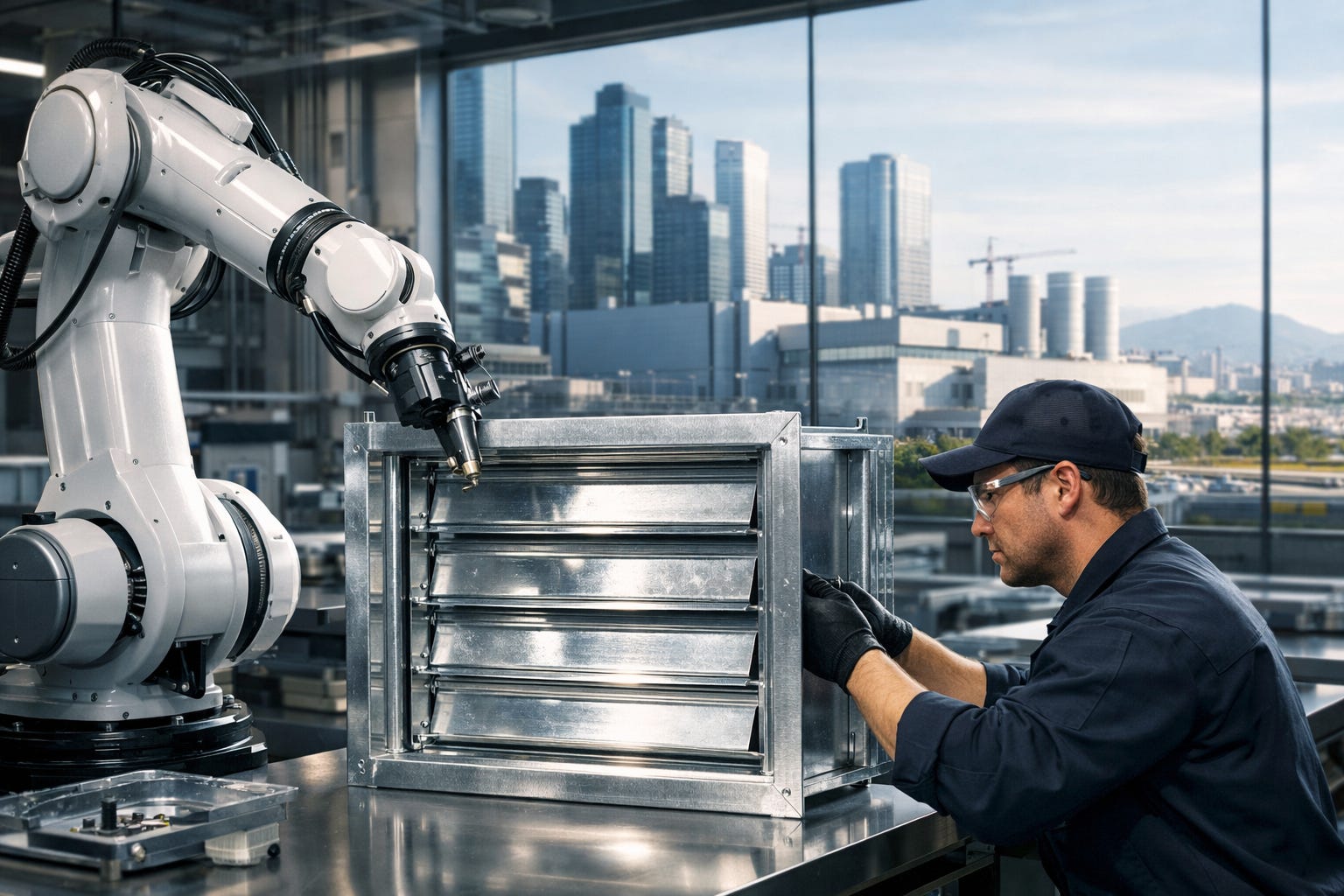
Interestingly, Kyoritsu is focusing hard on automation and the elimination of human-labour.
They call this ‘human-robot collaboration’.
They even have specific targets for reducing the number of ‘man-hours’ across their factories, and have made good progress hitting them in recent years.
They’re also trying to release higher-margin products in the residential sector. The idea here is to improve margins.
All in all, they’re a mediocre business trying to improve.
They’re generally profitable and management is actively trying to implement ideas to push things forward.
The Financials
The statements over the last 5 years reveals a stable, mature manufacturing business that is managed conservatively.
It is not a high-growth company, but it is resilient against economic shocks.
The business generates cash through a straightforward manufacturing model.
It buys raw materials, converts them into HVAC dampers and systems, and sells them to large, credit-worthy customers.
The cash engine is capital intensive, and requires factories, robots, and inventory.
It’s also volatile. Over the last 5 years it has generated a peak OCF of ¥990M and a low of ¥283M.
Sales have been stable, generally hovering between ¥9.9B and ¥11.9B.
In 2020, sales dipped to ¥9.92B due to the pandemic but recovered to ¥11.92B by 2025.
The management team has proven they can maintain top-line revenue even when housing-starts in Japan decline.
The business operates with thin but consistent Operating Profit margins, typically ranging from 5% to 6%.
In 2022, margins compressed significantly due to soaring raw material prices, cutting profit by 21.4%.
However, management successfully recovered profits in 2023 and 2024 through price adjustments and cost reductions, showing they have some pricing power.
I mention this to illustrate the disconnect between the reality of the operating business and the pessimism implied in the current price.
The main attraction here is, of course, the balance sheet.
As of 2025, the company holds ¥4.15B in Cash and Deposits and ¥1.25B in Investment Securities.
This total liquid value (¥5.4B) exceeds the entire market capitalization of the company.
The assets are real, factories, machinery, and land.
There is very little fluff or goodwill (intangible assets are negligible at ¥82M).
The most significant hidden value is the Land, recorded on the balance sheet at ¥2.96B.
Under Japanese GAAP, this is recorded at historical cost (what they paid for it years ago).
Frustratingly, the reports don’t indicate the current market valuation or even the size of the land area.
However, it houses the factories and productive assets of the entire business.
Given the company’s long history, I reckon the current market value of this real estate is far higher than the book value.
It’s something to dig into deeper if you like this idea.
The business is obviously over-capitalised, and has far more cash than it needs to operate.
This is inefficient, but it guarantees survival.
This is important because re-ratings take time, and I like to sleep soundly at night.
Overall, Kyouritsu Air Tech is a financially indestructible business.
It generates reliable cash flow, has zero net debt, and sits on a mountain of cash and undervalued real estate.
Why It’s Cheap & Risks
This one is pretty simple.
Management gives off ‘value trap’ vibes.
They generate cash but refuse to pay it out significantly, choosing instead to let it pile up on the balance sheet or invest in low-yield securities.
They also make no mention of the Japanese governance reforms or any kind of plan to increase shareholder returns.
I think the market basically assumes that all the cash and assets will remain trapped inside the business.
The business itself also isn’t growing.
It’s stable, but the market loves to price in growth above all else.
Of all the things going on here, these are the issues that seem to be holding the stock back the most imo.
There are a few things that could damage the business but nothing that would particularly concern me as a private owner.
The biggest risk here is that of the management team continuing to hoard cash.
Despite this, the returns can still be market-beating.
This all comes down to how compressed the valuation is, and how much upside potential is baked into the current price.
Over the last year, for example, the stock rallied almost 26%, which is more than most major indexes.
Despite this, it still trades at a 40% discount to its assets.
The Investment Case
The investment case for this type of stock goes something like this:
The balance sheet provides an enormous margin of safety through its liquid assets and (probably) undervalued land.
It will continue trundling along for many years into the future.
There is an almost zero risk of it ceasing to exist as things stand.
The only possibility is some kind of blatant accounting fraud, where the assets don’t really exist.
From that base of continued operation, it’s likely that the operating business will do something positive in the next few years.
Or, an activist starts building a stake to unlock the value.
Or, the management team finally starts to feel the pressure of the ongoing governance reforms.
Or, the stock price will simply keep grinding higher at a slightly faster pace than the general market, boosted by the incredibly low valuation.
Something like this will happen at some point, because it always does.
This only really works if you buy a group of these kinds of stocks.
You certainly don’t want to put all your life-savings into Kyoritsu Air Tech.
However, if you can find 15 or 20 of them, the dynamic changes.
The portfolio generates the returns and each individual stock matters much less.
As I mentioned before, this is probably the simplest form of deep-value investing and a situation that provides massive downside protection for your capital.
If you like this idea, I estimate there is roughly 150% upside to the TBV of the business and 65% upside to the fair value (based on the earnings).
I don’t hold this stock because it’s not as good as the Japanese stocks I own already.
If I did buy it, my target would probably be around ¥1250 per share.
If you’re interested in accessing my personal portfolio stocks, you can do so via an annual subscription.
The annual plan includes access to bonus content that you might find interesting.
Learn more about the bonus content here.
Get a 90% discount off Bloomberg’s No.1 competitor. Get a 30-day free trial here