
Get a 90% discount off Bloomberg’s No.1 competitor. Get a 30-day free trial here
“In the early days, all he did was look for stocks trading at roughly 30% of book value and just back up the truck.”
- Charlie Munger, on Warren Buffett.
Today’s stock is one that early-Buffett might have liked.
The market has already written off the operating business, so we don’t really need to worry about that.
In fact, the operating business is priced as if it will be a permanent liability.
Draining cash from the balance sheet, until the business withers away and dies.
As usual, this is probably over-pessimistic.
In fact, over the last 5 years, the FCF yield of the business is roughly 9%.
This may not be very exciting but it’s also far from a dying business.
The shareholder yield isn’t very exciting either.
Last year’s yield was 1.64% and the TTM yield is 3.78%.
This boost is thanks to a buyback they recently conducted.
The good news is that there is no SBC or share dilution going on.
There is also no concentrated ownership to speak of.
From what I could gather, insiders and friendly shareholders seem to collectively control around 40-50% of the voting power.
This is after factoring in all the treasury stock the business holds.
This means that we’re safe from one of the biggest killers of deep-value investors.
The dreaded involuntary delisting.
Here are the ratios:
NCAV Ratio = 0.4
TBV Ratio = 0.38
P/5Y FCF Ratio = 11.3
The enterprise value is negative at -¥11.5b.
The current market cap is ¥6.6b.
This alone illustrates the extreme disconnect between price and value.
If we bought this business at today’s market cap, we’d actually end up with almost double the amount of cash we just paid.
This business is pretty simple so the FCF figure didn’t require too many adjustments.
Working capital swings around, but this is all cash used by the operating business.
The business also generates significant income from its investment portfolio. It receives interest and dividend income.
This goes into OCF, but that’s fine by me.
If I was buying this business, I’d count this as income all the same.
The tangible book value is around ¥17.7b and the NCAV is ¥16.5b.
The difference here between market cap and tangible asset value is so extreme, that this set-up was impossible to ignore.
The play here is simple:
Buy the stock, use the assets as downside protection, and then sell when something even remotely positive happens with the operating business.
The Business
Kaneshita Construction (1897.T) is a Japanese business that operates in two main segments:
Construction Business: This engages in civil engineering, architectural construction, and other general construction work.
Manufacturing and Sales Business (and Others): This primarily involves the manufacturing and sales of asphalt products used in paving and construction.
Weirdly, as of 2024, this segment also includes a food and beverage division operating a conveyor belt sushi restaurant.
In 2024, the company generated ¥9.74 billion in total external sales.
Most of the revenue (96%) comes from construction.
Within the construction segment, 52.5% of revenues come from civil engineering and 47.5% comes from architectural construction.
They work exclusively in Japan, for both public (governments) and private sector clients.
The company is actually highly skilled.
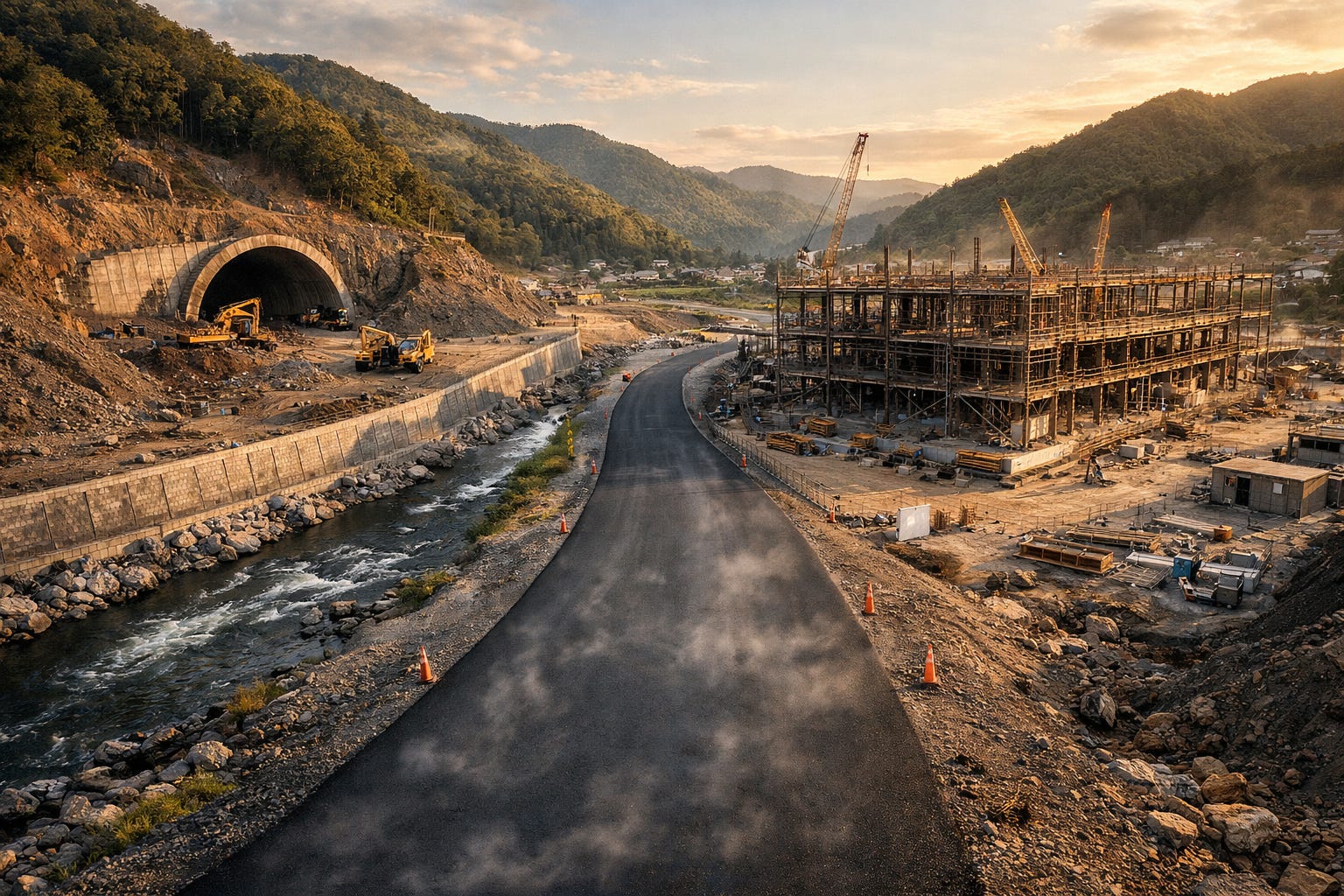
It’s capable of carrying out everything from heavy public infrastructure projects (roads, tunnels, bridges, sewage treatment plants), to specialised private projects.
The private works include things like nursing homes, hospitals, factories and retail facilities.
They even built a highly specialised garrison facility for a US military radar base.
Recently, the business has struggled.
In 2024, the company won a staggering amount of new orders and stuffed their pipeline full of new work.
This indicated that future cash-flows would gush out, as that work was completed.
This was when they also decided to open a sushi restaurant.
Anyway, the problem with all this was that as they started ploughing through all the new work, problems started occurring.
First, revenues dropped (23%), and then operating profits vanished (96%).
The problem is that they just can’t execute the work very efficiently.
The main issue seems to be with finding and hiring highly skilled workers in the construction industry.
During the last twelve months this became a real drain, as the work ramped up but the company couldn’t execute in line with the increase.
This seems cyclical in part but there also seems to be some basic management incompetence at play too.
For example, their response to these issues was to buy back some stock, try to conserve margins and open a sushi restaurant.
They succeeded in opening the sushi restaurant (which lost money), failed to protect margins, but did buy back the stock.
The buybacks are great, but they don’t really solve the core issues with the business.
They also abandoned quarterly forecasts and guidance.
Again, rather than actually trying to fix the issues, they seemed to just stop reporting on them so often.
All in all the business is a long-term asset that has plenty of work and plenty of brand value, but is lacking competent leadership.
The plus side is that the market is already paying us to take the operating business.
All of this is already priced into its natural (worst case scenario) conclusion.
The death and destruction of the business.
The reality is that the business is so cash-rich that it would take decades of continued incompetence to do any real damage.
All we need for a significant re-rating here is for the business to show that it will probably stay alive after all.
In the real-world, this is a pretty low bar.
The Cash-Engine
The most interesting insight from the statements is the fact that Kaneshita generates quite a lot of cash from investments.
For example, in 2024, operating profit was ¥273m, but ordinary profit was ¥479m.
The difference is the extra cash generated by their cash-hoard and investments.
This isn’t big enough for the business to survive off alone, but it does mask the weakness of the core operating business.
For us, as deep-value investors, it also provides a nice buffer to help us ride out the current volatility in the operating business.
The other insight is that a massive chunk of operating cash flow comes from changes in working capital.
This is perfectly normal for a construction business, but it also explains why its more useful to use a multi-year average to gauge FCF.
Surprisingly, the business doesn’t spend much at all on capex.
This makes it easier for revenues, profits and cash-flows to flow through to the owners unimpeded.
The main issue with Kaneshita is that its cash engine is far too dependent on human labour.
While the construction labour shortage goes on, the business can’t actually execute all the orders it has and convert them into cash.
However, when that issue is resolved, the business seems perfectly capable of trundling along as it always has.
The Assets
The star of this show are the assets.
Specifically, the cash and highly-liquid assets.
Right now, the business has zero debt and an equity ratio of 82%.
Even if we ignored every asset except the cash, we could pay off all liabilities and still have enough cash to cover the market cap.
Here’s what the asset base is mostly composed of:
Cash = ¥9.9b
Marketable securities = ¥8.69b
Invoices = ¥1.97b
The company also has property assets.
It carries its land at a historical book value of ¥1.21b.
Under Japanese accounting standards, land is held at its original purchase cost rather than current market value.
Given the company’s long operating history (almost 100 years) this real estate is highly likely worth significantly more in a real-world liquidation or sale scenario.
The most compelling part of this set-up is the sheer liquidity of the balance sheet.
Yes, it’s overcapitalised, but it also provides the mother of all protections against loss of capital (for us).
When I’m buying cigar butts, this is the exact type of set up I look for to help me sleep soundly at night.
Why It’s Cheap
The main reason seems to be that the market is pricing in the value-trap scenario.
An incompetent/indifferent management team and an operating business struggling to make money.
The implication is that this will all result in the business draining all its cash and being liquidated.
The business is facing challenges which are both external and internal.
All this creates uncertainty which the market simply runs away from.
They also decided to open a sushi restaurant…
The Risks
The biggest risk is in the operating business itself and its current inability to execute works it has already won.
This has occurred through a combination of external factors (inflation, labour shortages), and management incompetence (sushi restaurants).
If they can’t turn things around and start generating profits again, the business really will burn through all its cash and liquidate.
I agree that the situation is highly uncertain, but the market reaction totally ignores the massive cash-pile underwriting everything.
The biggest risk by far, therefore, is the management team itself.
The Investment Case
In the real-world, it’s highly improbable that a business like Kaneshita would just burn all its cash and liquidate.
Even incompetent management teams can’t bear cash burn for too long.
The fact they hoard cash demonstrates how much they dislike the prospect of losing money and going out of business.
They also have an entire team of people working on solving the very issues causing the cash burn.
The most likely scenario, in the real-world, is that they try to get the operating business profitable and back on track.
They will succeed in one way or another, eventually.
The business has been going for 100 years after all, and the issues are all internal rather than anything existential.
Any hint of success is the kind of news we need to get a significant re-rating of the stock.
This is the type of stock you hold as part of a diversified group of net-nets or cigar butts.
While we can’t say for sure how this particular stock will perform in the next 1-3 years, we can be fairly certain that a group of them will generate an outsized return.
In this case, we have a reasonable possibility of all the major catalysts occurring.
First, the business could complete the turnaround required to get back on track.
Second, an activist or competitor could scoop them up for a massive discount, while still paying a large premium on today’s price.
Finally, they have more than enough cash to conduct significant buybacks or even a special dividend.
The current price is ¥3,280 per share.
My target here would be based purely on the value of assets, which is ¥9,237 per share.
I don’t own this stock yet, because it’s not better than my current Japanese holdings.
If you’d like to view the exact stocks I own, you can do so with an annual subscription.
The annual plan includes access to other bonus content that you might enjoy.
Get a 90% discount off Bloomberg’s No.1 competitor. Get a 30-day free trial here