
Get a 90% discount off Bloomberg’s No.1 competitor. Learn more here
Today’s stock is a cyclical business priced at the trough, with around 50% upside to its fair value, as I calculate it.
The enterprise value of the business is €84M and the market cap is €171M.
I’ve calculated the EV conservatively, including all forms of debt obligation (leases etc), minority interests and all liquid assets (marketable securities rather than just cash).
Being cyclical, we need to use the 5Y FCF figure to smooth out all the ups and downs from working capital, and separate maintenance capex from growth.
My owner-adjusted 5Y FCF figure is currently €19.75M.
This is the money I could realistically extract from the business (If I owned it whole), on average, each year, to buy yachts.
This is particularly relevant because today’s business literally sells yachts.
Here are the valuation ratios:
NCAV Ratio = 3.3
TBV Ratio = 1.6
EV/5Y FCF Ratio = 4.3
P/5Y FCF Ratio = 8.6
As you can see, this isn’t a liquidation play. It’s a bet on the future continuation of the business.
Besides being fairly cheap, the shareholder yield here is currently 4.1% on a TTM basis.
I like these scenarios because it means we get paid while we wait for the catalyst to arrive.
Over the last 5 years the dividend has grown at a rate of 11% (CAGR).
In summary, the market is implying that the operating business is worth nothing and will wither away and die over the next few years.
Meanwhile, the reports show a profitable, cash-rich luxury-brand that’s investing heavily in its future.
This disconnect is where we make money.
Let’s take a closer look…
The Business
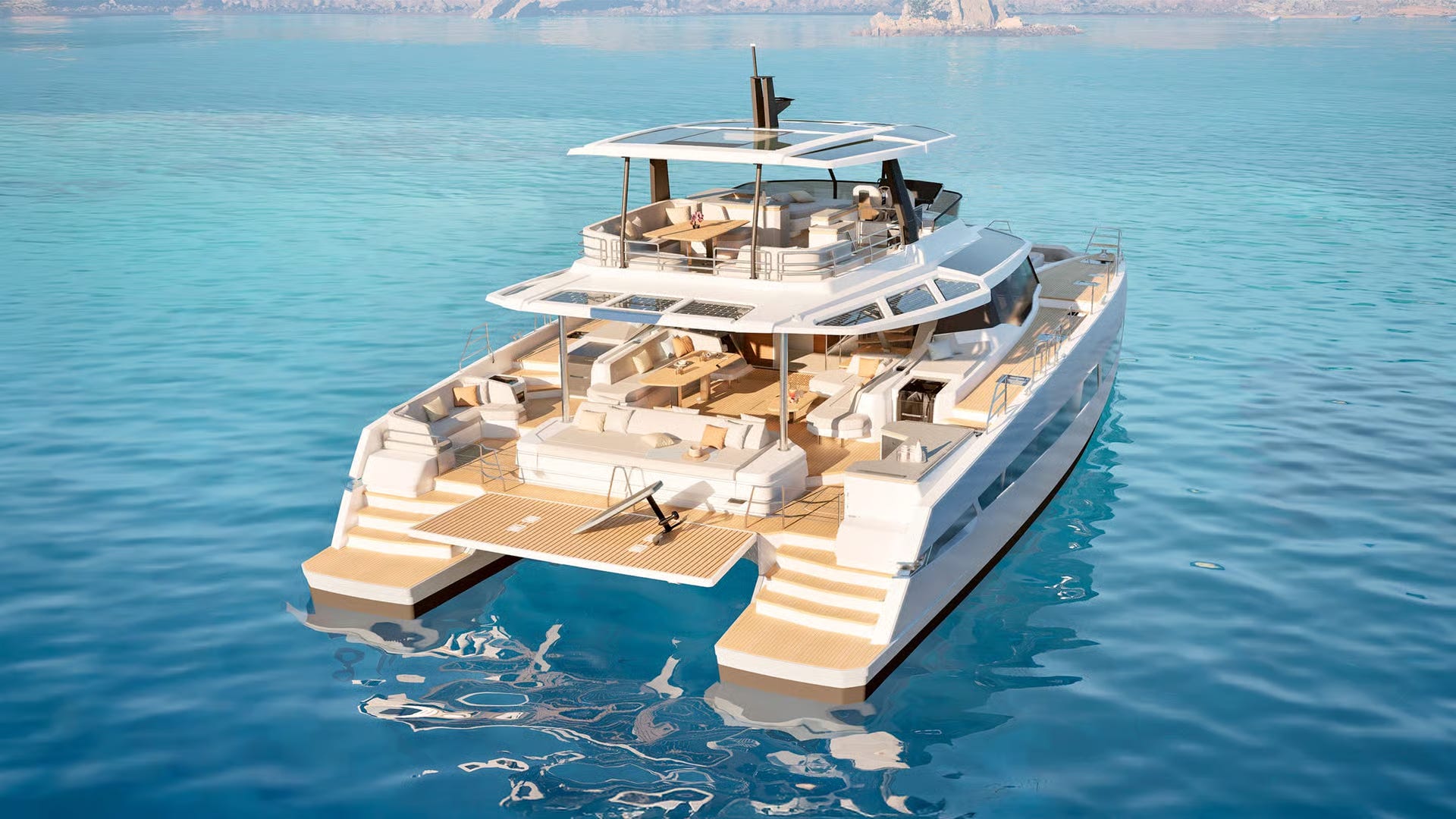
Fountaine Pajot SA (ALFPC) is a French producer of yachts and catamarans.
In case you’re wondering, a standard-yacht has one hull while a catamaran-yacht has two.
The business operates out of four industrial sites in France.
They originally focused only on catamarans but acquired a yacht-builder (Dufour Yachts) in 2018.
Because I can’t be bothered to keep typing ‘’catamarans’, I’ll simply be using the word ‘boats’ from here.
If you’re a wealthy deep-value investor, and you want something to sail between the Canary Islands and the Caribbean, FP can build it for you.
They recently acquired some US dealer subsidiaries to help them tap into the retail margins.
Apparently, building the boats is nice, but the real cream comes from being the dealer, selling to end-clients.
That’s where the fat margins are.
Last year (FY25) they turned over €323.2M in total revenue across the group.
Of this, €280.9M (87%) came from the core business of building and selling boats.
€56.0M (17%) came from selling boats they didn’t build (trade ins or resales etc).
€13.8M (4%) came from other services such as chartering and rentals.
I know what you’re thinking…
That breakdown of revenue segments doesn’t add up to €323.2M, and those percentages total 108%.
This is down to the fact that top-line revenue is reported after dealer-commissions have been paid.
The breakdowns above (as reported) are gross of those commissions, so they look higher.
This tells us that the business relies heavily on middle-men to sell their boats, to the tune of roughly 10-15% of the total sales volume.
This is probably why they decided to acquire some dealers.
Over the last five years, this transition from basic ‘boat-builder’ to vertically integrated group has been the main focus.
This played out in three phases.
First, there was the COVID boom. There was a surge in demand as rich people wanted to get out of the house.
Revenues grew from €172M in 2020 to €220M in 2022.
To secure manufacturing slots, customers paid massive deposits upfront.
This created a temporary ‘super-liquidity’ event where the company’s cash pile swelled before the boats were even built.
The primary challenge was actually building those boats.
The company faced supply chain disruptions and inflation but managed to maintain production continuity.
To cope with demand, they switched to a single production line for Dufour yachts to improve efficiency.
Next, they decided to conduct a strategic pivot.
Management realized that to capture those juicy margins, they needed to own the distribution channel.
In 2023, they aggressively expanded into the United States (their largest export market) by acquiring majority stakes in their dealer networks (TYSC Holdings, Yacht Charter Services, ACY Texas).
FY2023 was a record year with revenue hitting €276.8M.
Finally, everything normalised and levelled out.
Revenue peaked in FY2024 at €351.3M before correcting to €323.2M in FY2025.
This is due to the business building the boats that everyone bought during phase one, which has burned through some of the cash.
Despite the revenue dip, the business is structurally far larger and more profitable than in 2021.
Net income in 2025 was €29.9M, nearly triple the €11.6M earned in 2021.
They invested heavily in building out their group, which should translate in even bigger cash-flows during the next part of the cycle.
Management is currently working on a few things.
First, they are trying to decarbonize their fleet and stay ahead of the ever-tightening regulations.
This seems to be going well.
By 2023, they had launched 5 ‘Smart Electric’ boats and pushed towards 20 by 2024.
This positions them as a premium, future-proof brand as regulations on emissions tighten.
Secondly, they are building out their ‘vertical integration’ strategy.
As mentioned, this is designed to capture all the margins that are currently leaking out through unrelated dealers.
The integration is financially complete as of the 2025 report.
The group now controls a significant portion of its distribution, which protects margins even as sales volumes normalise.
Finally, my favourite is their capital allocation and return strategy.
This is more ‘implied’ than specifically stated, but everything looks very shareholder friendly.
As mentioned earlier, dividends are increasing at a nice clip and they’re also constantly buying back shares at market rates.
Although the buybacks are relatively small, it’s still nice to see.
In summary, management has successfully navigated the company from a €170M revenue builder (2020) to a €320M+ vertically integrated group (2025) with tripled net profits.
The current cash burn and revenue dip in 2025 appear to be a controlled landing from the COVID boom.
The US acquisition strategies are setting the stage for the next cycle of growth.
The Financials
The financials show a business that is structurally sound but that operates in a cyclical manner.
They generate operating cash-flow by essentially pre-selling their boats to clients. This creates an influx of cash onto the balance sheet.
The business then has to buy all the materials and pay all the labour to actually build those boats. Whatever the difference is becomes the profit (or loss).
This can create an illusion of either extreme profitability or loss-making at any given time.
This is played out via the changes in working capital, which impacts the FCF figures from year to year.
This is why I use the 5Y average figures, to smooth that cycle out and give us a realistic picture.
Despite being volatile, revenues have grown over the years. They were €207M in 2019 and hit €323M in FY25.
Operating cash flows have also been similarly volatile but robust and reliable. Growing from €21M in 2019 to over €40M in FY25.
The balance sheet is a fortress.
Cash has grown from €46M in 2019 to almost €125M in FY25.
Net-debt is negative, which means they have more cash than debt. In fact, the net-cash figure is around 70% of the current market cap.
Over 70% of the assets are tangible. 40% of total assets are cash and equivalents, with inventory making up 22%.
I consider the quality of inventory here to be extremely high. Boats can’t be sold quickly but they will almost certainly all be sold.
Receivables (trade) here are pretty low. In the reports they are valued at €13.38M.
This shows us the pricing power of FP. They get paid first and build the boats later. That’s quite a rare set-up in business.
It’s also another clue that the business might be worth significantly more than the market is currently pricing in.
There’s more.
The business owns a significant amount of land and property.
In 2022, they sold one of these assets in a real-world transaction. This gives us a little insight into the disparity between book value and market value.
The implied book value of this asset was €360K but the sale price was €1.42M, which is around 4x more.
If we apply this same logic to the remaining land and property assets, we end up with a much larger margin of safety from tangible assets.
The remaining assets are located in Aigrefeuille and La Rochelle industrial areas.
Apparently, real-estate prices there have surged over the last decade.
These core sites are still on the books at their historical cost.
Digging around in the reports it seems like the Aigrefeuille assets were more than likely purchased decades ago (maybe the 90s or even earlier).
The La Rochelle assets were built in 2020 and the remaining assets were acquired with the Dufour Yachts acquisition in 2018 (and marked up at 2018 values).
That means the Aigrefeuille site is the main point of focus.
In 2023, the board announced an extension facility of that site, costing €3.5M.
If a mere extension costs €3.5 million, the existing massive industrial footprint (which sits on the books for a fraction of that) is surely drastically undervalued.
We’re getting into speculative territory, but that site alone seems to be worth in the tens of millions at today’s prices.
It’s certainly something to dig into deeper if you’re considering buying the stock and want maximum margin of safety.
In summary, the financial statements show a financially robust, cash-rich builder of cool boats.
Yes, they are facing cyclical issues and some temporary headwinds (the Dufour acquisition has been written down), but overall the business is solid.
The enterprise value is low because the market cap is nearly covered by the cash pile, and the market is pricing in permanent decline of the operating business.
Why It’s Cheap
There are a few things going on at PA that keep the stock price depressed.
First, there is the Dufour Yachts debacle.
The acquisition of Dufour Yachts (monohulls) has been a drag on the group’s performance and capital efficiency.
The market likely penalises the stock for this poor capital allocation.
The company has admitted that Dufour is worth far less than they paid.
In 2023, they recorded a €13M impairment on goodwill. By 2025, the total accumulated depreciation on goodwill reached €19.45M.
Dufour Yachts also lost a tax dispute, forcing the company to impute over €3.3M of its carry-forward deficits, further impacting its financial efficiency.
In other words, the catamaran business (Fountaine Pajot brand) generates high margins, but the consolidated results are diluted by the struggling monohull division.
The market sees this (correctly) as bad capital allocation.
This has a knock on effect on how the cash is viewed.
Basically, if the management team are bad allocators then the cash probably isn’t worth as much as stated on the balance sheet.
The market is betting they will just waste it on more bad acquisitions or similarly poor allocations.
The business is also at the trough end of the business cycle. It’s burning cash to service the customers it generated a few years ago.
This just looks bad to anyone casually glancing at last year’s financials.
Finally, the ownership structure isn’t ideal for minority investors.
The business is owned (53%) by a family holding company called La Compagnie du Catamaran.
The problem is that their shares have double voting rights of the normal shares.
This gives them 70% of the voting rights.
Despite this the risk of an involuntary delisting is actually quite low because the listing rules state they need 90% to force that through.
The rest of the voting rights (and stock) is spread pretty thin across individual investors, none of whom hold any kind of majority.
This would make it difficult to achieve the extra 20% required to shaft those very shareholders.
The structure does, however, make it impossible for any kind of activist investor to build a meaningful stake.
We’re essentially at the whims of the controlling family as they build (or burn) their legacy over time.
These things all combine to keep the stock price relatively cheap.
The Risks
There are general risks to this business, with cyclicality being the main one.
Then there are business-specific risks to PA directly.
These include the issues faced with the Dufour Yachts division, which was a bad investment. In 2022 the parent had to sub Dufour to the tune of €5M.
Dufour could become a drag over time, although the issues here mainly stem from the price they paid.
The big risk here is that the controlling family runs the business into the ground and burns all its cash.
If you want to have full conviction in this idea you need to dig into a few things more deeply.
First, and foremost, dig into whether the Dufour is operating at a structural loss.
The 2025 report notes the entry into force of a ‘fiscal integration’ regime between Fountaine Pajot and Dufour.
While this allows the group to pay less tax by offsetting Dufour’s losses against Fountaine Pajot’s profits, it confirms that Dufour is generating losses.
We need to be sure that Dufour will become profitable soon and stand on its own two feet.
Overall, the question here is whether or not PA can continue as a healthy cash-generative business over the next 5 years.
If it can, then the stock price will likely re-rate to something more akin to fair value.
The Investment Case
The core idea here is that we buy the cash and the real-estate and get the operating business for virtually nothing.
The current EV price values it at just 4x the average FCF.
This implies a permanent decline in earnings for the foreseeable future and the eventual closure of the business.
The reality just doesn’t reflect that view.
The balance sheet quality will sustain it through almost any storm (pun intended), while the operating business consistently generates cash.
Yes, it’s lumpy, but this business is healthy, not in structural decline.
There is unlikely to be a buyout anytime soon. The family controls it and are getting nice cash-flows from it.
They also seem to have a desire to grow it and expand their legacy.
There is also unlikely to be any kind of special dividend or buyback programme. They prefer to keep the cash on hand to ensure smooth running of the business.
That leaves us with the operating business as the main catalyst.
For this to kick in, the business needs to see FCF profits return in the next 1-2 years, and signs of growth from their recent acquisitions.
If they start receiving those extra dealer margins, it could see the FCF rise beyond its current 5Y average.
This alone would be a great place to sell the stock and take profits.
Right now, given what they have been doing I’d value this business, today, at around €150 per share.
Although the current price probably isn’t cheap enough for me right now, I am watching it closely (mostly because I love staring at the catamarans).
Get a 90% discount off Bloomberg’s No.1 competitor. Learn more here