
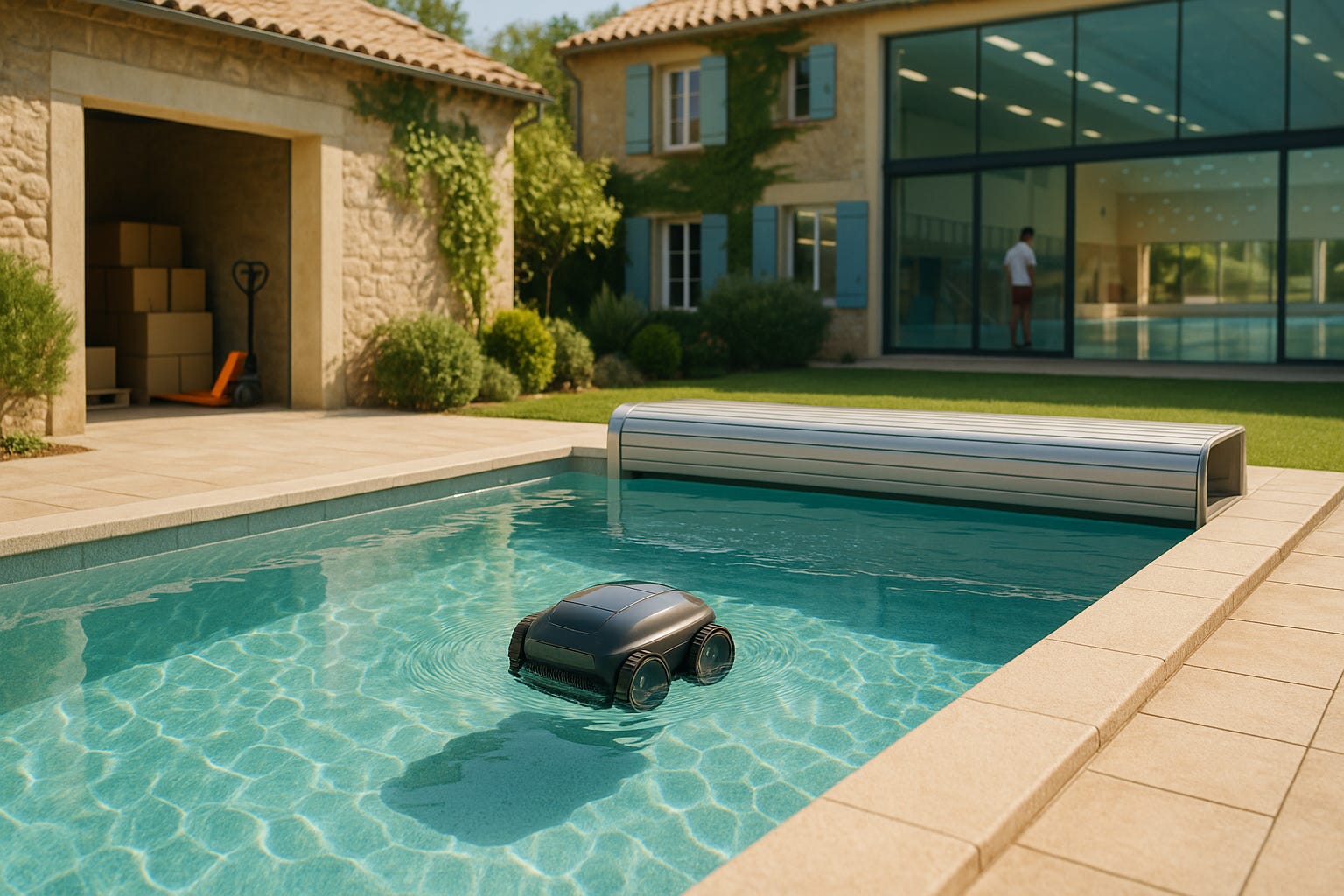
Deep-value investors go crazy for net-nets.
You’ll often hear them say things like:
“If I could only invest in one strategy, it’d be net-nets.”
While I love net-nets, I prefer to have a bit of variety in my portfolio, so I would never confine myself to any single strategy, like that.
Having said that, I’m always partial to a net-net and actively search for them most weeks.
Here are the ratios for today’s stock:
NCAV Ratio = 0.5
TBV Ratio = 0.5
EV/5Y FCF Ratio = 4
P/5Y FCF Ratio = 5.5
This is quite a rare type of net-net.
It’s a net-net that’s also trading cheaply to its recent earnings.
It’s also based in a decent (ish) country.
Let’s take a look…
The Business
MG International S.A. (ALMGI) is the French operating arm of Maytronics, the Israeli group best known for “Dolphin” robotic pool cleaners.
In France it trades as ‘Maytronics France’.
It imports Maytronics-made robots, sells them into French retail and installer channels, and also designs and manufactures its own automatic pool covers.
MG International buys finished Dolphin robots from the Maytronics group and resells them B2B across France.
This is its largest revenue stream.
It runs a selective dealer network for the key ranges, and supports retailers with a logistics hub near Aix-en-Provence.
MG also earns attractive after-sales revenue because robots, apparently, need one or two major repairs over their life, which drives parts sales.
Unlike the robots, MG actually designs and manufactures its automatic pool covers itself at La Ciotat, in France.
These go to the same broad customer base of pool retailers and builders.
Under the Poseidon brand it sells AI-based drowning-prevention systems to municipalities and operators of public pools.
Revenues include the initial project plus long-term service contracts covering software licences, monitoring and hardware maintenance.
R&D is in France; operations are handled in France and via Poseidon Technologies Inc. in the United States.
The financials for the US subsidiary are not included in their reported financials, so everything in this write up is focused only on the French operation.
One interesting little side note is that in France, apparently, every ground-level pool, without a fence, is required by law to have a pool alarm system installed.
The fine is €45,000 for non-compliance.
I guess this provides solid demand for companies like MG.
They mostly sell to private-pool owners in France and public-pool operators in both France and across Europe.
The ‘Dolphin’ brand of robot pool-cleaners is regarded as the market leader. This gives it somewhat of a ‘moat’ for the business.
Think of MG International as the French ‘go-to’ supplier for premium pool cleaning robots, with its own factory for motorised safety covers, and a specialist safety-tech line for public pools.
It imports and distributes robots made by the parent group to French retailers and installers, backed by selective dealer programmes and pre-season “early-buy” stock arrangements.
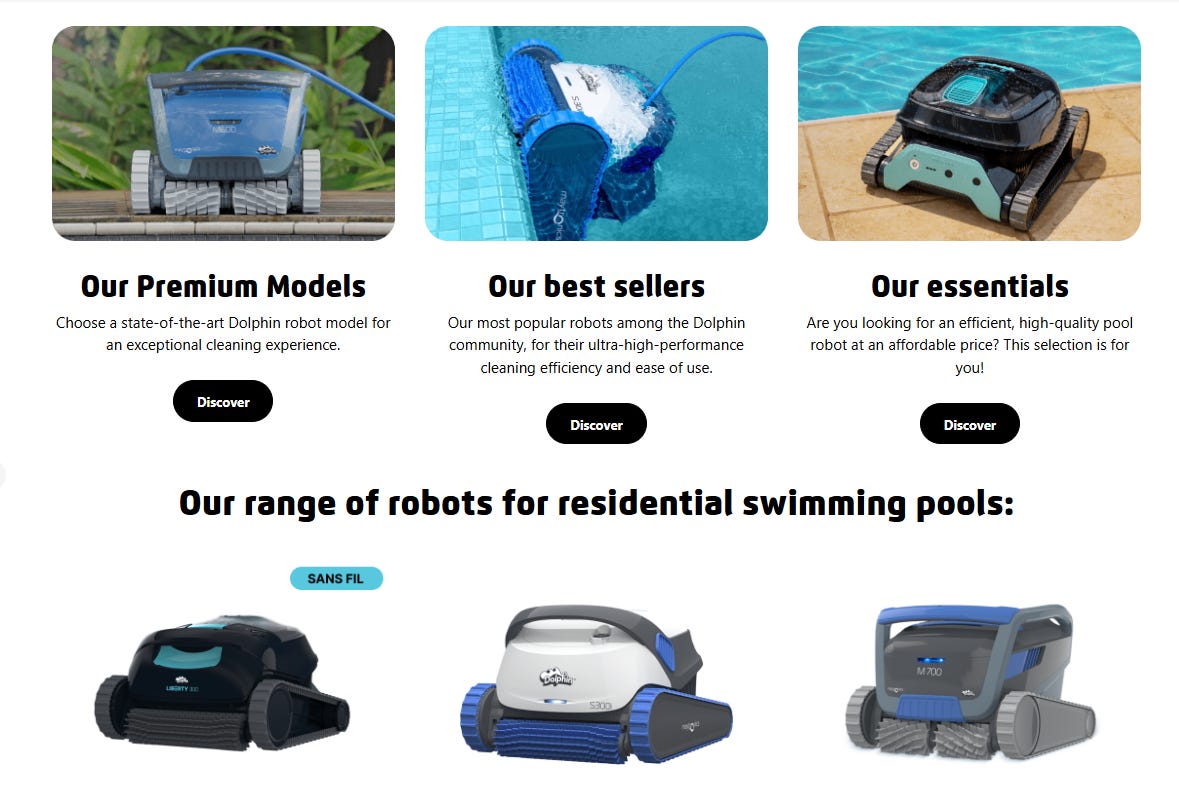
It also runs after-sales and spares, which matter because robots usually need one or two significant repairs during their lifetime, creating recurring parts revenue.
MG Manufactures its pool covers locally, giving it a product it controls end-to-end.
Finally, it delivers long-term service contracts for Poseidon systems in public pools.
Apparently the robot-cleaning market is getting more competitive.
The reports note established competitors such as Fluidra and BWT, plus a recent wave of lower-priced Chinese entrants that sell directly online.
MG International’s response is to segment offers by channel, lean on brand and service quality, and support dealers with logistics and stocking programmes.
Why It’s Cheap
Generally speaking, the market has priced this business above its fair value (as I calculate it), and its liquidation value (based on tangible assets).
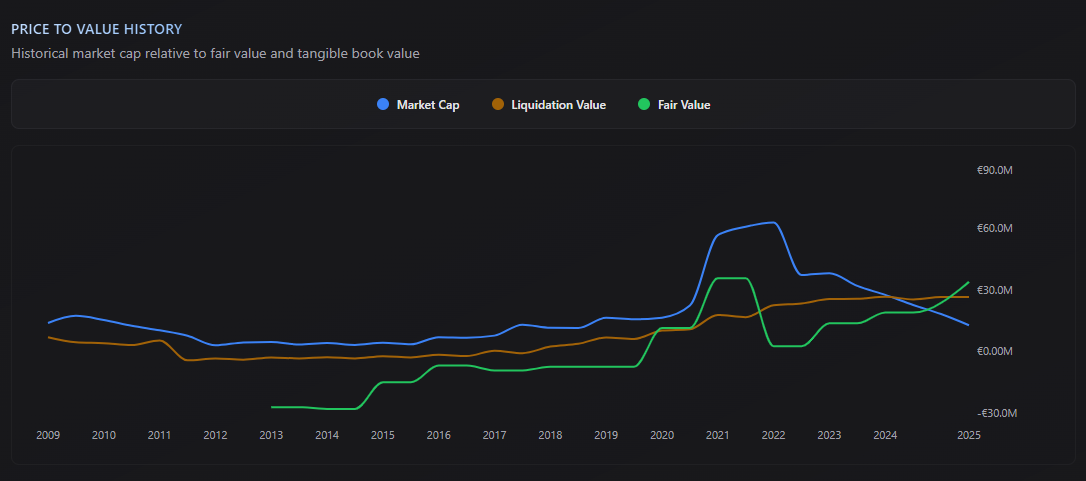
It’s only in the last couple of years that the price has fallen significantly below its intrinsic value.
The most recent price drop has been caused by a decline in revenues and general macroeconomic concerns.
For example, In H1 2025 revenues are down 24% YoY.
In 2022, they peaked at €83m and started to decline to €70.5m in 2023, €59.5m in 2024 and the TTM is sitting at €49m.
The pre-COVID levels were around €45m, and the surge in demand was one factor behind the strong share price growth.
To exacerbate the drop in demand, Chinese suppliers started aggressively entering the European market, selling direct to consumers, online, at vastly discounted rates.
The bottom line is that the stock price has reacted (downwards) to the recent struggles the business has had with maintaining its peak revenues.
The Risks
If you’re tempted by this little net-net, there are a few things you should be aware of.
First of all, as mentioned, the French pool-equipment market has been shrinking for a third straight year after a pandemic-era boom.
Management says first-half 2025 revenue fell 24%, and they expect the downward trend to persist into the second half, which is both seasonally smaller and less profitable.
Tight cost control and payroll discipline have already cut operating expenses by 15% year on year in H1 2025, helping to defend profitability despite lower sales.
The company continues to emphasise its market leadership in electric robots and immersion-detection alarms.
Next, the company notes the arrival of new competitors in robotic pool cleaners, increasing price pressure in the core category.
The mitigation here is by focusing on the premium end of the market, improving the product range and taking advantage of their brand-moat.
Finally, there is a risk of customer concentration.
A meaningful share of revenue is concentrated in the largest accounts.
The top 3, 5 and 10 customers represented 26%, 36% and 49% of 2024 sales, respectively. The prior year was 30%, 40% and 52%.
This is also kind of a shield against the competition, but it does leave their revenues further exposed if that competition somehow eats into those long-held relationships.
Aside from these core business-risks, there are several general risks that MG faces.
These include things like, seasonality, FX fluctuations, Inventory becoming obsolete, a dependence on key suppliers, and various legal, macroeconomic and geopolitical risks.
None of these general risks concern me too much.
What does concern me more than anything is the ownership structure of the company.
The largest shareholder, Maytronics Ltd, holds 73%.
This means that the company is tightly controlled and it’s virtually impossible for any activist to ever build a stake large enough to exert influence.
I couldn’t track down the full story, but the reports suggest that the business IPO’d in 2007, after launching in 2002.
Maytronics Ltd started building its stake several years later, and did so over a number of years via private and on-market transactions.
We don’t know the future intentions of Maytronics, but it seems reasonable for them to take advantage of a very low stock price.
When this situation is present it usually means that a cheap stock becomes a private company at a criminally low price.
In other words, the biggest risk here is the risk of an involuntary delisting below our average.
This risk, arguably, gets larger the cheaper the stock gets.
The Investment Case
There isn’t going to be any activist buyout due to the ownership structure.
There probably isn’t going to be any kind of game-changing buyback strategy, because MG tends to favour dividends.
But they only do that when they feel like it, which is not very often.
That leaves the main catalyst, mostly likely to generate a re-rating, as being a return towards peak revenues.
I don’t even think we need to surpass or even hit the peak revenues. They just need to start growing again back up, above pre-COVID levels.
That should be enough to boost the stock price and provide a 50%-100% return in the next 2-3 years.
The case for that happening is as follows:
They are a market leading brand, and have experience with growing revenues.
The annual reports point to several lasting tailwinds that were built during the Covid-era upswing and that should keep a floor under revenues.
For example, they now have a much larger installed base of pools and robots in France.
Management highlights that electric robots typically need one or two major repairs over their life and that spare-parts sales have been rising to service this bigger base.
That is a structural, recurring stream that persists even when new unit sales slow.
They, now, also have a broad, selective dealer network built out in those boom years.
The company reports representation for key ranges in more than 1,200 specialist shops, supported by an external logistics hub and a national service and spares centre.
That channel footprint and service infrastructure endure beyond the ‘cycles’ and help support volume when demand returns.
Next, they have improved production capacity and lead times in their automatic covers division.
The La Ciotat plant added automated equipment in 2021, effectively doubling capacity, and reports ongoing lean improvements.
By 2023 the site was running short lead times and remained comfortably over-capacitised above 10,000 covers per year, which positions the business to meet a rebound without bottlenecks.
If demand stabilises, this mechanism can accelerate restocking and shipment recovery.
There also appears to be secular support for the automatic-covers.
Reports note that covers have shifted from pure safety to design and comfort, and they now carry an additional water-saving rationale in drought-affected regions.
This increases the number of reasons for customers to buy and may sustain the category through cycles such as this one.
They have also achieved some diversification through the Poseidon public-pool safety offerings.
Poseidon’s long-term service contracts, with activity in France and internationally, provide a services layer that is less tied to the private-pool renovation cycle.
Therefore the investment case can be boiled down to the following:
The boom lifted channel breadth, service and logistics capability, manufacturing capacity and, crucially, the installed base that drives spares and repairs.
None of these look temporary, in the reports.
They will not fully offset a weak private-pool market or low-price entrants on their own, but they should help revenues stabilise and support a move back toward mid-cycle levels when demand normalises.
In other words, they are in a prime position to scale revenues back up, as soon as demand normalises.
When revenues start to reflect that stabilisation and growth (from current depressed levels) the re-rating should follow pretty quickly imo.
Aside from this, the business is currently priced below the value of its net-current-assets.
Usually, any kind of earnings growth from the lows is enough to generate a chunky stock rerating.
I believe this stock is primed for such a ‘bounce back’ as soon as revenues stabilise above recent levels.
A big chunk of capital tied up in inventory/stock in a down-cycle, which is exactly where you don’t want to be if the market stays weak.
And the SSL certificates on their website (company name without spaces or dashes + .fr) expired 7 days ago.. normally when I see such things it shows a lack of love for the detail. Also some product sites (Greek god name + .fr) do not work anymore etc., so at least based on their websites it seems only the main company brand is being properly taken care of.
Is it cheap even after discounting/applying a heavy cut on inventory?
It seems this company is being hollowed out by the main shareholder (take a look at branding, comingly of websites, e. g. deliveries to Italy are not made by the company active in FR)..